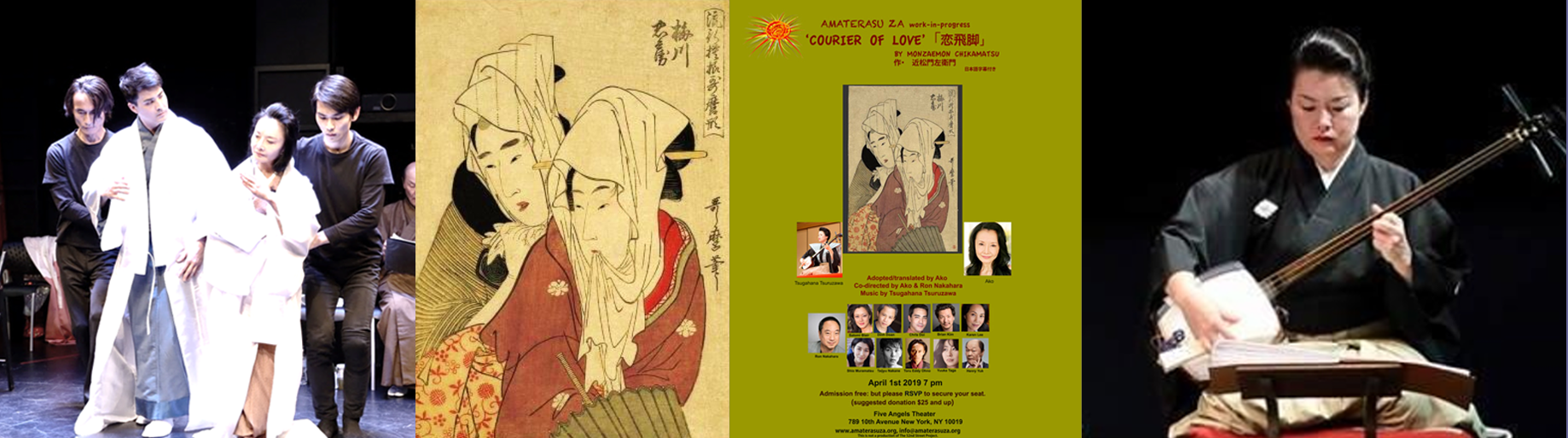
Courier of Love
A work-in-progress performance based on the plays of Monzaemon Chikamatsu
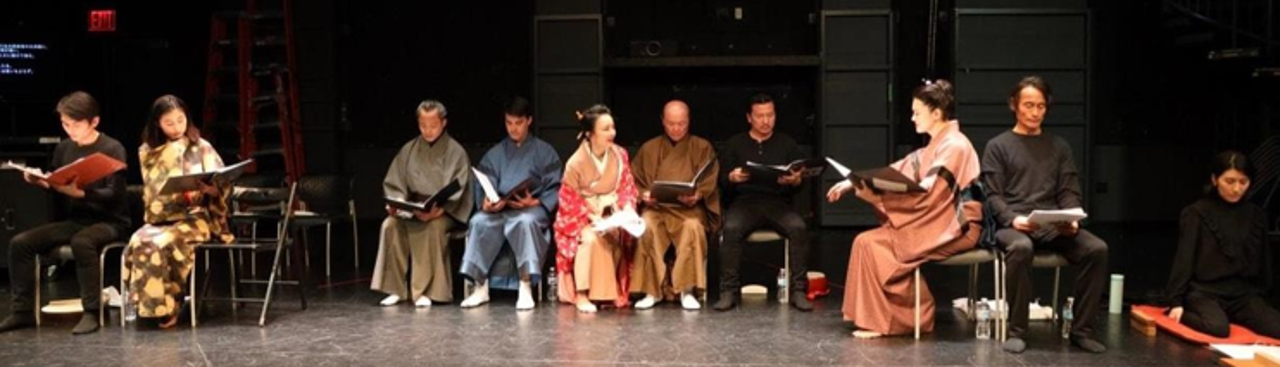
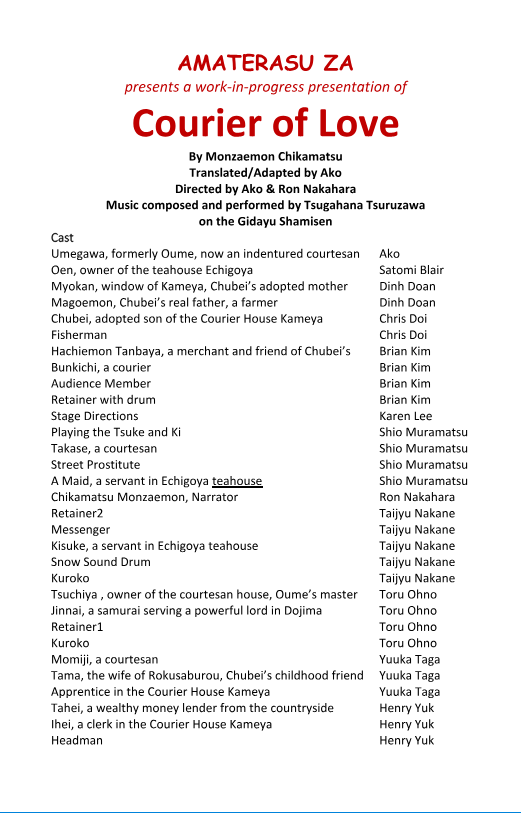
In 2019 we were very excited to present a work-in-progress presentation of Courier of Love, in English with Japanese supertitles. When I decided to start Amaterasu Za, a theate company dedicated to bringing the power of Japanese drama to an American and Japanese-American audience in English and Japanese, it seemed obvious that one of the projects I’d undertake would have to be rooted in the great Japanese stage traditions of Kabuki and Bunraku.
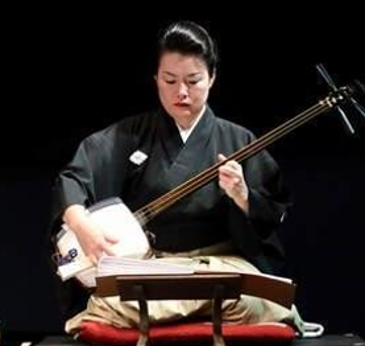
Kabuki, a form created by a woman but today performed exclusively by men, and Bunraku, the amazing form of puppet theater with live music and narration, both emerged in the 17C. Monzaemon Chikamatsu (1653–1725), often called “the Japanese Shakespeare” wrote more than 130 works which form an important part of the repertoires of both the Bunraku puppet theater (for which the majority were originally written) and the Kabuki stage. Chikamatsu collaborated closely with the great Takemoto Gidayu (1651-1714), a chanter who narrated the stories and voiced all the dialogue for the puppets accompanied by the earthy sounds of a special version of a stringed instrument called a Gidayu Shamisen, which provided a rich emotional underscoring throughout. This tradition of chanter and musician has survived to this day. It is known as Joruri, and you we were lucky to be joined in this presentation by a great Gidayu Shamisen musician from Japan, Tsugahana Tsuruzawa who specializes in this theatrical technique. She composed and performed new underscoring that works with our new English text, something quite new that we were excited to experiment with.
Chikamatsu’s plays include Jidaimono (historical romances) and Sewamono (domestic tragedies) that combine comic and tragic elements and are full of keenly-observed characters from the Osaka of his day; servants, merchants, housewives, prostitutes, criminals, and lovers. Often based on actual events, his big sweeping historical play include spectacular battle scenes, but his domestic tragedies offer the richest, most moving relationships. Like Shakespeare’s star-crossed lovers Romeo and Juliet, Chikamatsu’s tragic lovers face obstacles of money, honor, and family obligations. His tragic romances include heart-breaking farewells to parents, and lovers that decide to die together rather than be parted.
Its rare today, even in Tokyo, to see Kabuki plays performed in their entirety. Instead a typical afternoon at the Grand Kabuki-Za includes famous scenes from several plays. It seemed to me that with small adjustments it would be possible to combine some of the most famous aspects from three of Chikamatsu’s moving double-suicide plays, ‘Courier of Hell’ ‘Double-Suicide at Sonezaki’ and ‘Love Suicides at Amijima’ into one play, ‘Courier of Love’ and tell a coherent story; The Tragedy of Chubei and Umegawa.
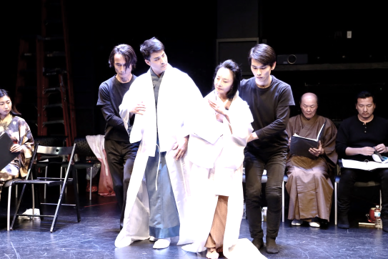
One of the joys of Japanese theater is the unabashed theatricality of it. Neither Bunraku or Kabuki are naturalistic forms; they employ theatrical conventions (puppets operated by three extremely visible people; old men playing young women, suddenly striking a woodcut-ready pose called a mie that captures a character’s extreme emotional state which always brings down the house, etc.). When Chikamatsu had written a play for Bunraku and it became popular, he would often adapt it for the Kabuki stage. And this led to one of the most unique features of the Kabuki tradition – Ningyo-Buri. There are certain famous scenes in the Kabuki dramas that were originally Bunraku puppet plays, in which the actors, who have been speaking their lines and moving in the normal Kabuki manner up until this point, suddenly shift styles and perform a climactic scene as if they are Bunraku puppets, making reference to the beloved origin of the piece, and displaying an amazing tour-de-force of physical theater. We incorporated that into this peice at a pivotal moment!
What we presented reflected just a one-week workshop of the piece. We read the entire play, staging some of the most moving scenes to give the audience and ourselves an idea of where we hoped to take this piece as we developed it further.
Ako, Artistic Director, Amaterasu Za
VIDEO- Workshopping ‘Courier of Love’ 2019 - 2 mins